

Search doesn’t look the way it did two years ago. A growing share of the people who used to click through ten blue links are now getting a direct, AI-generated answer instead — from Google’s AI Overviews, from ChatGPT, from Perplexity, or from Gemini. For Dubai businesses that built their online growth around traditional SEO services and paid search, this shift changes what “being found online” actually means in 2026.
This isn’t a distant trend anymore. It’s already affecting click-through rates, ad performance, and how customers discover local businesses. This guide breaks down what’s actually changed, what’s overhyped, and the practical steps Dubai businesses should be taking right now.
The Core Shift: From Ranking to Being the Answer
For nearly two decades, digital marketing revolved around one goal: rank as high as possible in search results so people click through to your website. That model isn’t gone, but it’s no longer the whole picture.
<cite index=”9-1″>Google’s own 2026 guidance describes optimizing for its generative AI features as still fundamentally being SEO</cite>, but the practical reality is that a new layer has been added on top. Increasingly, AI answer engines like ChatGPT, Perplexity, and Google’s AI Overviews synthesize a response directly from multiple sources rather than sending the user to a website at all. <cite index=”11-1″>When this happens, users get the value of your content and associate it with your brand without ever clicking through to your site.</cite>
This has given rise to what’s now commonly called Generative Engine Optimization (GEO) — the practice of structuring content so AI systems find it, trust it, and cite it in their answers, rather than just ranking it in a results list.
What GEO Actually Means (And Why It’s Not Replacing SEO)
There’s a lot of noise around GEO right now, with some agencies pitching it as a completely separate discipline. The reality is more grounded: <cite index=”11-1″>GEO is not a replacement for SEO but an additional layer, and the brands succeeding at GEO in 2026 are typically the same ones with strong existing SEO foundations.</cite>
What GEO adds on top of solid SEO fundamentals:
- Front-loaded answers. <cite index=”11-1″>AI systems that pull information in real time, like Perplexity and Google’s AI Overviews, judge a page’s relevance mainly by its opening content, so the first couple hundred words of any page should directly answer the main question instead of building up to it slowly.</cite>
- Citation-friendly structure. Clear headings, direct Q&A formatting, and well-labeled sections make it easier for AI systems to extract and cite specific pieces of your content.
- Stronger authority signals. <cite index=”9-1″>GEO practice leans heavily on the same E-E-A-T principles — experience, expertise, authoritativeness, and trustworthiness — that have shaped SEO for years, along with earning citations from credible external sources.</cite>
- Data and specificity. Research on the topic has found that <cite index=”15-1″>adding direct quotes, statistics, and cited sources measurably increases how often content gets referenced in AI-generated answers, with quotes alone boosting visibility by nearly 28%.</cite>
In practical terms: businesses that have been investing in genuinely useful, well-structured content marketing are already positioned well for this shift. The core discipline hasn’t changed — the destinations your content needs to satisfy have simply multiplied.
How Big Is This Shift, Really?
It’s worth putting a number on it rather than treating this as vague hype. <cite index=”17-1″>According to EMARKETER’s forecast, nearly a third of the US population will use generative AI search in 2026</cite> — and UAE adoption of AI tools, particularly among younger, mobile-first consumers, tends to track close behind US and European trends. <cite index=”2-1″>Google’s AI Overviews already appear for roughly 15% of all search queries</cite>, and that share is expected to keep climbing through the year.
For a Dubai business, this means a meaningful and growing portion of potential customers may see an AI-generated summary of your industry before they ever see your website — or a competitor’s. Whether your brand is mentioned in that summary, described accurately, and positioned favorably is quickly becoming as important as your position on page one of Google.
Where AI Is Already Changing Google Ads
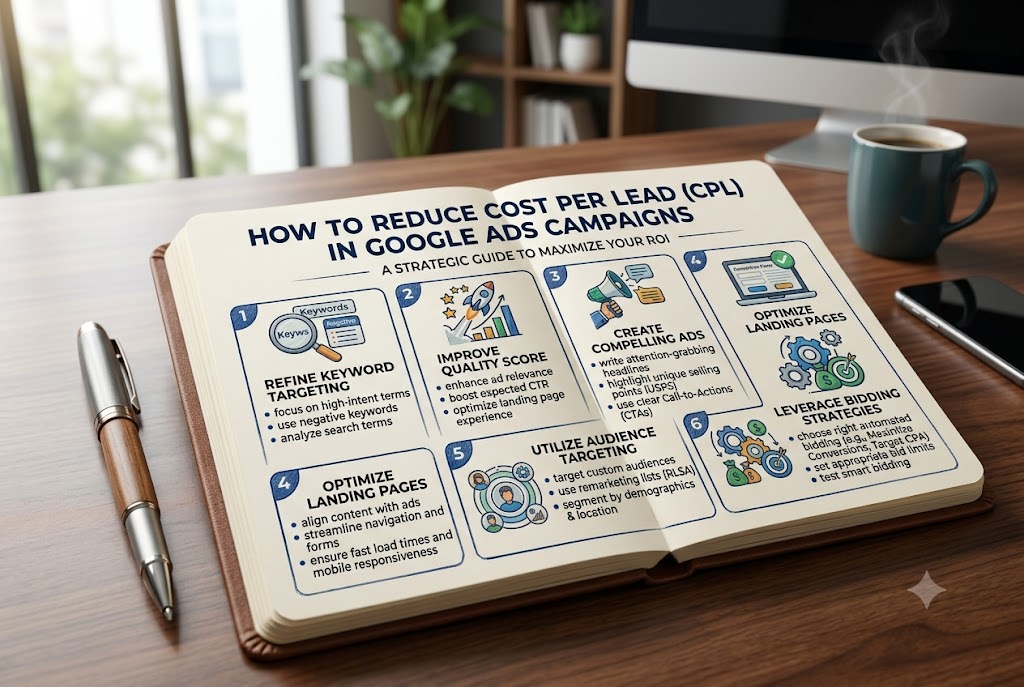
Beyond organic search, AI has become deeply embedded in how Google Ads campaigns actually run. <cite index=”3-1″>In 2026, advertisers are seeing AI’s impact concentrated in four areas: predictive audience targeting, real-time bid optimization, dynamic content personalization, and automated performance reporting.</cite>
What this means practically:
- Automated bidding is now the default, not the exception. Google’s algorithms react to signals — device, time of day, user history — faster than any manual bid adjustment could. Businesses still relying purely on manual CPC bidding are increasingly leaving performance on the table.
- Ad copy personalization happens in real time. Dynamic ad variations are tested and served based on what’s converting for a specific audience segment, not a single static ad.
- Reporting is shifting from monthly reviews to continuous monitoring. Automated anomaly detection now flags underperforming campaigns far faster than a manual weekly check ever could.
<cite index=”3-1″>However, human oversight hasn’t become optional — AI is genuinely good at generating content and optimizing at scale, but human intervention is still needed to maintain quality and catch costly errors before they compound.</cite> This is a point we’ve seen play out directly: campaigns that hand full control to automation without regular human review tend to drift off-strategy over time, chasing short-term signals instead of the business’s actual growth goals.
The Personalization Expectation Has Gone Up
Customers in 2026 expect a level of relevance that generic campaigns simply can’t deliver anymore. <cite index=”2-1″>Digital marketing this year is being reshaped by AI-driven personalization, generative AI for content creation, and increasingly immersive experiences that enable hyper-targeted campaigns at scale.</cite>
For a Dubai business, this shows up in very tangible ways:
- Email and WhatsApp follow-ups that reference a customer’s specific inquiry, not a generic template
- Landing pages that adjust messaging based on the campaign or location a visitor came from
- Retargeting sequences that reflect exactly what a visitor viewed, rather than a blanket remarketing ad
This connects directly to lead conversion. A landing page or ad experience that feels tailored to the visitor’s specific need consistently outperforms a generic one — a principle that matters just as much in website design as it does in ad targeting.
A Cautionary Note: AI Isn’t a Substitute for Local Judgment
Not every AI trend translates cleanly across markets, and this is a genuinely important caution for Dubai and UAE businesses specifically. <cite index=”2-1″>One documented case involved a global brand’s AI-driven campaign that scheduled sends based purely on historical engagement data — the algorithm scheduled a major campaign push during a national day of mourning in one region, a cultural event the system had no data on, and open rates in that market collapsed by 68% with a significant hit to brand sentiment.</cite>
This is a critical lesson for a multicultural, multi-market city like Dubai. AI tools are excellent at pattern recognition within the data they’re given, but they don’t inherently understand local context — Ramadan timing, UAE public holidays, cultural sensitivities across different customer segments, or regional preferences that a generic global dataset simply won’t capture. Any AI-driven automation — scheduling, content generation, or bidding — still needs a layer of local human review before it goes live.
What’s Overhyped vs. What’s Actually Worth Doing
It’s easy to feel pressure to adopt every new AI tool that gets marketed as essential. Here’s a grounded breakdown of where the real value is.
Genuinely worth prioritizing in 2026:
- Structuring website and blog content so it can be clearly understood and cited by AI systems (clear headings, direct answers, schema markup)
- Using AI-assisted bidding and audience targeting within Google Ads, with human review built into the process
- Personalizing follow-up communication (email, WhatsApp) based on actual customer behavior, not generic segments
- Monitoring how your brand appears when customers ask ChatGPT or Google’s AI Overview about your industry or service
Overhyped or premature for most local businesses:
- Fully autonomous AI agents running entire campaigns without oversight
- Chasing every new AI platform the moment it launches, before it has meaningful user adoption
- Replacing genuine customer testimonials and case studies with AI-generated “social proof”
- Treating AI-generated content as ready to publish without human editing and fact-checking
How to Check If Your Business Is Visible in AI Search Right Now
This is a simple exercise any Dubai business owner can do today, and it takes less than fifteen minutes.
- List 10–15 questions your customers would realistically ask — things like “best AC repair company in Business Bay” or “acupuncture clinic for back pain Dubai.”
- Ask these questions directly to ChatGPT, Perplexity, and Google (checking whether an AI Overview appears).
- Note whether your business appears, how it’s described, and which competitors or sources are cited instead.
- Identify the gap. If competitors are being cited and you aren’t, it usually points to thin content, missing structured data, or a lack of authoritative pages on your site addressing that specific question directly.
This single exercise often reveals more about your actual online visibility gaps than a traditional keyword ranking report — because it shows exactly what a potential customer sees the moment they ask.
Practical Steps for Dubai Businesses in 2026
1. Audit your existing content for direct-answer structure. Review your top service pages and ask: does the first paragraph clearly and completely answer the main question a visitor came with? If it takes three paragraphs to get to the point, both users and AI systems will look elsewhere.
2. Strengthen structured data and schema markup. This has always mattered for SEO, but it’s now equally important for helping AI systems correctly parse and cite your content. Service pages, FAQs, and location pages should all carry proper schema.
3. Build genuinely authoritative, specific content. Generic, templated pages perform worse in both traditional and AI-driven search. Location-specific and condition-specific pages — addressing a real customer question directly — consistently outperform broad, catch-all pages.
4. Keep a human in the loop on all automation. Whether it’s AI-driven bidding, AI-generated ad copy, or automated email sequences, build in a regular human review step, especially around culturally sensitive timing like Ramadan, UAE public holidays, and regional events.
5. Monitor your AI visibility alongside your traditional rankings. Add “how does my brand appear in ChatGPT and AI Overviews” to your regular reporting, not just Google ranking position. This is becoming as relevant as traditional rank tracking.
6. Don’t abandon fundamentals for novelty. Strong SEO services, well-structured content marketing, and conversion-focused website design remain the foundation everything else builds on. AI amplifies a strong foundation — it doesn’t replace the need for one.
Frequently Asked Questions
Is traditional SEO becoming irrelevant because of AI search?
No. <cite index=”9-1″>Google’s own position, as summarized by industry reporting, is direct: because AI Overviews and AI Mode are built on core Search ranking systems, optimizing for generative AI search is still fundamentally SEO.</cite> GEO builds on strong SEO rather than replacing it.
Should my business start using AI-generated content for blogs and ads?
AI can speed up drafting, but published content still needs human review, fact-checking, and a distinct brand voice. Fully AI-generated content without editing tends to read generically and performs worse for both readers and AI citation purposes, which favor specific, well-sourced information.
How do I know if AI search is affecting my business specifically?
Run the visibility check described above — ask ChatGPT, Perplexity, and Google directly about your services and see whether your business is mentioned. If it isn’t, and competitors are, that’s a clear signal to prioritize GEO-focused content improvements.
Is this relevant for small, local Dubai businesses, or just large brands?
It’s arguably more relevant for local businesses. AI answer engines are increasingly used for local, specific queries — “best,” “near me,” “for [condition/need]” — which is exactly the kind of high-intent search local service businesses depend on.
Final Thoughts
AI isn’t replacing digital marketing strategy in 2026 — it’s changing which fundamentals matter most and adding a new layer most businesses haven’t optimized for yet. The businesses that will benefit most aren’t the ones chasing every new tool, but the ones that pair genuine subject-matter authority and clear, well-structured content with smart use of automation — and keep human judgment firmly in the loop, especially for a market as culturally specific as Dubai and the wider UAE.
If you’re not sure how your business currently shows up in AI search, or where your content is falling short, get a free consultation and we’ll walk you through exactly where the gaps are.