


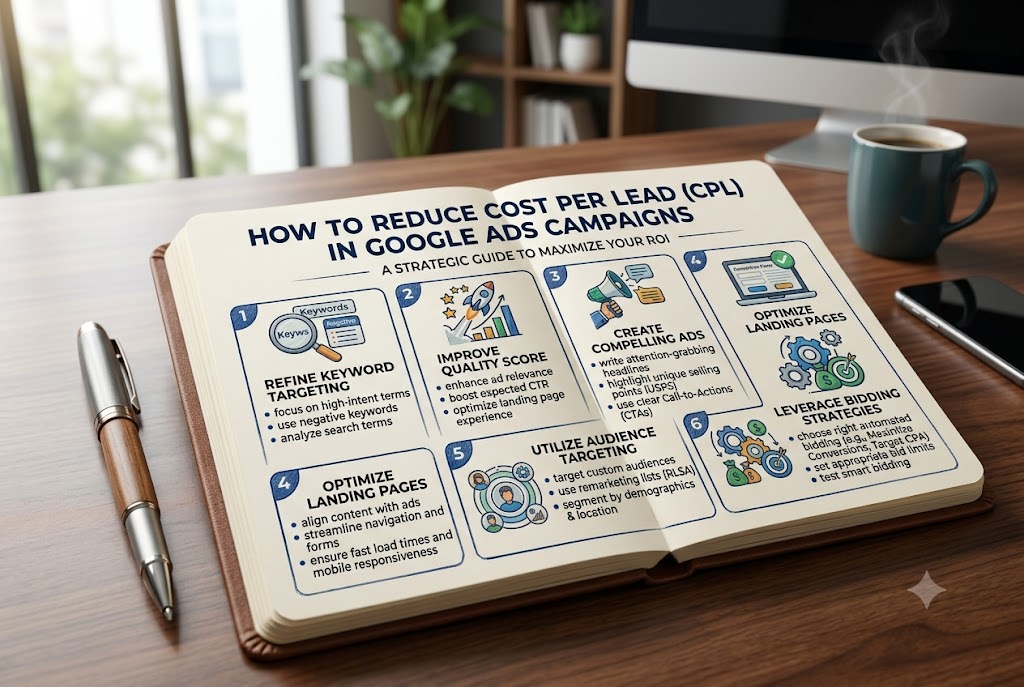
Every business running Google Ads in Dubai eventually asks the same question: why is my cost per lead so high, and how do I bring it down without losing lead quality? It’s one of the most common frustrations we hear from business owners — the campaign is generating clicks, the budget is being spent, but the cost of each qualified lead keeps climbing instead of settling into a predictable, profitable range.
The good news is that cost per lead (CPL) is rarely a mystery once you break it down. It’s shaped by a handful of controllable factors — keyword selection, ad relevance, Quality Score, landing page experience, bidding strategy, and audience targeting. Fix these one at a time, and CPL almost always comes down.
This guide walks through exactly how to reduce cost per lead in Google Ads, with practical, Dubai-market-relevant strategies you can start applying today.
What Is Cost Per Lead and Why It Matters
Cost per lead is simply the total amount you spend on a campaign divided by the number of leads it generates. If you spend AED 5,000 in a month and get 100 leads, your CPL is AED 50.
But CPL alone doesn’t tell the full story. A campaign with a low CPL but poor lead quality can actually cost your business more in the long run — your sales team wastes time on unqualified inquiries, and conversion-to-sale rates drop. That’s why reducing CPL has to go hand in hand with maintaining or improving lead quality. The goal isn’t just cheaper leads; it’s cheaper leads that still convert into customers.
This is also why CPL should never be looked at in isolation. It connects directly to your broader performance marketing in Dubai strategy — the channels, creatives, and tracking systems that determine whether a lead actually turns into revenue.
1. Fix Your Keyword Strategy First
Keyword selection is the single biggest lever affecting cost per lead. Broad, generic keywords attract high volumes of low-intent clicks that rarely convert, while overly narrow keywords limit reach. The sweet spot is intent-driven, moderately specific keywords.
What to do:
- Prioritize high-intent keywords. Terms like “book AC repair Dubai” or “get free quote website design Dubai” signal someone ready to act, unlike broad terms like “car repair” or “marketing tips.”
- Use negative keywords aggressively. Review your search terms report weekly and add irrelevant queries as negatives. This alone can cut wasted spend by 15–30% in most accounts.
- Separate branded and non-branded campaigns. Branded searches almost always convert cheaper. Mixing them with non-branded terms in one campaign distorts your real CPL and makes optimization harder.
- Match keyword intent to funnel stage. Top-of-funnel keywords (“what is SEO”) belong in awareness campaigns with different goals, not the same lead-gen campaign as bottom-of-funnel keywords (“hire SEO agency Dubai”).
A structured SEO services approach to keyword research — built around real search intent rather than guesswork — pays off equally well in paid search, since the same intent-mapping logic applies to both channels.
2. Improve Your Quality Score
Google’s Quality Score directly affects how much you pay per click. A higher Quality Score means Google rewards you with lower costs and better ad positions for the same bid. It’s calculated from three factors: expected click-through rate, ad relevance, and landing page experience.
Practical steps to improve Quality Score:
- Tighten ad group themes. Each ad group should target a small, tightly related set of keywords (5–15 max) so your ad copy can speak directly to search intent.
- Match ad copy to keywords. If someone searches “emergency plumber Business Bay,” your headline should reflect exactly that — not a generic “Professional Plumbing Services.”
- Use all available ad extensions. Sitelinks, callouts, structured snippets, and call extensions all improve expected CTR, which feeds directly into Quality Score.
- Audit landing page relevance. The page a user lands on after clicking should match the ad’s promise word-for-word in intent, not just topic.
Even a two-point improvement in Quality Score (say, from 5 to 7) can reduce your cost per click by 20–30%, which flows straight through to a lower CPL.
3. Rebuild Your Landing Pages Around Conversion
This is where most businesses lose the most money without realizing it. You can have perfect targeting and a low cost per click, but if your landing page doesn’t convert visitors into leads, your CPL will stay high regardless of how cheap the traffic is.
What high-converting landing pages have in common:
- A single, clear call-to-action — not five competing buttons
- A headline that mirrors the ad’s promise
- Trust signals above the fold (reviews, certifications, years in business, client logos)
- A short, low-friction lead form (name, phone, one qualifying question — nothing more)
- Fast load speed, especially on mobile, since most Dubai traffic comes from phones
- No navigation menu or distracting exit links pulling visitors away
If your current pages weren’t built with paid traffic in mind, it’s worth a dedicated redesign. Our website design services focus specifically on conversion-first layouts — UI/UX built around getting the visitor to act, not just look. Businesses that pair ad campaigns with a proper web development in Dubai approach typically see CPL drop by 20–40% purely from the landing page rebuild, without changing the ad spend at all.
4. Optimize Your Bidding Strategy
Manual bidding gives you control but requires constant attention. Automated bidding strategies, when set up correctly, often outperform manual bids because Google’s algorithms can react to signals in real time that a human can’t track manually.
Bidding approaches that typically lower CPL:
- Target CPA (Cost Per Acquisition) bidding once you have at least 15–30 conversions in the last 30 days — this gives Google enough data to optimize toward your target cost.
- Maximize Conversions for newer accounts still gathering data, then switch to Target CPA once volume is established.
- Avoid Target Impression Share for lead-gen campaigns — it optimizes for visibility, not cost efficiency, and tends to inflate CPL.
- Set realistic CPA targets. Setting a target too aggressively low will restrict your ad’s reach and can actually reduce lead volume without meaningfully cutting cost.
Bidding strategy should never be set once and forgotten. Review performance every 1–2 weeks in the first month of any change, since automated bidding needs a learning period before results stabilize.
5. Use Audience Layering to Filter Out Low-Intent Traffic
Search campaigns alone often bring in a mix of intent levels. Layering audience signals on top of your keyword targeting helps you bid more aggressively on genuinely valuable traffic and pull back on the rest.
Audience layers worth adding:
- In-market audiences relevant to your industry (e.g., “Home Services” for a repair business)
- Remarketing lists for search ads (RLSA) — past website visitors typically convert at a lower CPL than cold traffic
- Customer match lists built from your CRM, to exclude existing customers from lead-gen campaigns
- Demographic exclusions where your service genuinely doesn’t apply to certain age groups or income brackets
This layered approach connects naturally with social media marketing efforts too — audiences that engage with your brand on social platforms often convert cheaper when retargeted through search and display.
6. Restructure Campaigns by Location and Service
For Dubai businesses in particular, location-based restructuring is one of the most underused ways to cut CPL. Not every area of the city converts at the same rate or cost, and lumping all locations into one campaign hides this.
How to restructure:
- Split campaigns by service area (e.g., Business Bay, Ras Al Khor, Dubai Marina) if your business serves distinct zones
- Review the “Locations” report in Google Ads monthly and pause or reduce bids on consistently underperforming areas
- Adjust bids upward for high-converting zones rather than spreading budget evenly
- If you serve multiple emirates, run separate campaigns per emirate rather than combining them — Abu Dhabi and Dubai audiences often behave differently
This same logic — building targeted, localized structures instead of one generic approach — is central to how we approach SEO services in Dubai as well, where location-specific pages consistently outperform a single generic service page.
7. Test Ad Copy Systematically, Not Randomly
Many advertisers write two or three ad variations, let them run, and never revisit them. Systematic A/B testing of ad copy is one of the most reliable ways to reduce CPL over time because small improvements in CTR compound with Quality Score improvements.
A structured testing approach:
- Run at least 3 ad variations per ad group at all times
- Change one variable at a time (headline, CTA, or description) so you know what actually moved the needle
- Let each test run for at least 1,000 impressions before judging results
- Pause the lowest performer and introduce a new variant — keep this cycle continuous, not a one-time exercise
Strong ad copy also benefits from the same principles used in content marketing — clear value propositions, specific numbers, and language that matches how your actual customers describe their problem, not generic industry jargon.
8. Improve Conversion Tracking Accuracy
This is a step many businesses skip, but inaccurate tracking is one of the most common hidden causes of “high CPL” that isn’t actually real. If your conversion tracking is double-counting leads, missing phone call conversions, or not tracking form submissions correctly, your reported CPL will be misleading — and any optimization built on bad data will make things worse, not better.
What to check:
- Confirm phone call tracking is set up if calls are a primary lead source
- Deduplicate conversions between GA4 and Google Ads conversion tracking
- Set up offline conversion imports if leads are qualified manually by your sales team, so Google’s algorithm learns from actual sales outcomes, not just form fills
- Use conversion value tracking where possible, so Google’s bidding optimizes toward higher-value leads, not just lead count
Accurate tracking ties directly back into your broader performance marketing reporting — without clean data, every other optimization in this list becomes guesswork.
9. Time Your Ads Around Real Buying Patterns
Ad scheduling (dayparting) is often overlooked, but it can meaningfully reduce CPL, especially for service businesses where leads outside business hours are less likely to convert quickly or at all.
How to approach it:
- Pull the “Day & Hour” performance report after at least 60 days of data
- Reduce or pause bids during hours with high spend but low conversion rates
- Increase bids during your proven peak conversion windows
- Account for response time — if leads that come in overnight don’t get a callback until the next morning, they’re more likely to go cold and cost you a wasted conversion
10. Don’t Ignore Mobile Experience
The majority of search traffic in the UAE happens on mobile devices. If your landing pages, forms, or click-to-call buttons aren’t fully optimized for mobile, you’re paying for clicks that bounce before they ever have a chance to convert.
Mobile-specific fixes:
- Ensure forms are thumb-friendly with minimal typing required
- Use click-to-call buttons prominently, not buried in a footer
- Test page load speed on mobile specifically — a 1-second delay can drop conversions significantly
- Avoid pop-ups that are difficult to close on smaller screens
Putting It All Together: A Realistic Timeline
Reducing cost per lead isn’t a one-time fix — it’s a layered process. Here’s a realistic sequence for most Dubai-based service businesses:
Weeks 1–2: Audit tracking accuracy, clean up keyword lists, add negative keywords, restructure ad groups by intent.
Weeks 3–4: Rebuild or refresh landing pages for conversion, add ad extensions, launch A/B tests on ad copy.
Weeks 5–8: Layer in audience targeting, adjust bidding strategy toward Target CPA, review location-level performance.
Ongoing: Continuous testing, dayparting adjustments, and monthly search term audits.
Most businesses see the biggest single drop in CPL from landing page and tracking fixes — often before any bidding strategy change is even made. That’s usually the first place we start when auditing a new Google Ads account.
Frequently Asked Questions
What is a good cost per lead for Google Ads in Dubai?
This varies significantly by industry. Home services and repair businesses often see CPL in the AED 30–80 range, while higher-ticket B2B services can run AED 150–400+ per lead. What matters more than the raw number is your lead-to-customer conversion rate and the resulting cost per acquisition.
How long does it take to reduce CPL after making changes?
Search campaigns typically need 2–4 weeks of stable data after any major change (bidding strategy, landing page, or targeting) before results are reliable. Avoid judging performance too early or making multiple changes at once, as it becomes impossible to know what actually worked.
Should I lower my budget if CPL is high?
Not usually. Lowering budget restricts Google’s ability to gather conversion data and often makes automated bidding strategies perform worse. It’s better to fix the underlying issues — targeting, landing pages, tracking — before adjusting spend.
Can automated bidding really lower CPL more than manual bidding?
In most modern accounts, yes — once there’s enough conversion data (generally 15–30 conversions in 30 days) for Google’s algorithm to optimize effectively. Before reaching that volume, Maximize Conversions or manual CPC with close monitoring tends to work better.
Final Thoughts
Reducing cost per lead in Google Ads isn’t about finding one silver-bullet trick — it’s about systematically removing the inefficiencies in your keyword targeting, ad relevance, landing pages, tracking, and bidding strategy. Businesses that treat these as one connected system, rather than isolated settings, consistently bring their CPL down while improving lead quality at the same time.
If you’re running Google Ads and unsure where your budget is actually being wasted, a full account audit is usually the fastest way to find out. Get a free consultation and we’ll walk through exactly where your campaign can be tightened